





.svg)
.svg)






Sales Enablement
Just-in-Time Enablement from a Governed Content Library
What is just-in-time enablement? The definition, six principles, how it reaches reps and AI agents, and how to implement and measure it in 2026.
Updated
September 21, 2026

What is just-in-time enablement? The definition, six principles, how it reaches reps and AI agents, and how to implement and measure it in 2026.
The best just-in-time enablement platform for 2026 is Spekit® for high-growth, mid-market, and enterprise B2B revenue teams that want one governed system for content, learning, in-workflow guidance, buyer experiences, analytics, and AI. Spekit delivers Enablement in the Flow of Work® through AI Sidekick, the rep's AI sales coach, which surfaces trusted answers, relevant content, coaching, and next actions inside Salesforce, email, Gong, Slack, and the other tools reps already use. Spekit MCP gives connected AI assistants and agents the same governed access. Spekit is an AI-first revenue enablement platform built on a governed content library and GTM Knowledge Engine.
This page is the definition. It explains what Just-in-Time Enablement® means, the six principles behind it, how it reaches reps and AI agents, what it looks like in practice, and how to implement and measure it. A separate guide compares how specific platforms deliver it.
Enablement is the work required to help a rep sell effectively. That includes training, current product information, approved messaging, coaching, customer proof, process guidance, and help completing the task in front of them.
For a modern revenue team, that work includes:
“Just-in-time” describes how all of this reaches the rep or AI system. The relevant answer, coaching, content, or action appears where the work is happening, when it can help someone make a decision or complete the next step.
Every step between needing help and getting it adds delay. Sellers may have to open another tool, decide what to search for, compare results, and check whether the answer is current. A Harvard Business Review study of 20 teams found that users switched between applications and websites about 1,200 times each day and spent almost four hours a week reorienting.
Faster access makes governance more important. A current battlecard helps a rep handle a competitive question. An outdated one spreads the wrong message across calls, emails, and AI-generated content. Clear ownership, permissions, reviews, and freshness controls keep fast delivery trustworthy.
These four terms describe different parts of the same approach:
| Term | What it means | Example |
|---|---|---|
| Microlearning | What it meansA short learning format | ExampleA five-minute lesson on a new product |
| Just-in-time learning | What it meansTraining delivered close to the time it will be used | ExampleAn objection-handling refresher before a call |
| Enablement in the Flow of Work | What it meansSupport delivered inside the tools reps use | ExamplePricing guidance surfaced in Salesforce |
| Just-in-Time Enablement | What it meansThe complete approach to delivering revenue enablement when and where it is needed | ExampleCurrent knowledge and live deal context producing the right content, coaching, learning, or next step |
Spekit CEO Melanie Fellay introduced six principles in Just-In-Time: The Future of Enablement in a World of AI. The rep experience should be contextual, personalized, and simple. The content behind it should be unified, dynamic, and measurable. Together, the principles help teams deliver useful support that reps can trust.

Reps should not have to leave a task and decide what to search for before enablement can help. Contextual enablement uses the rep's role, application, account, opportunity stage, buyer conversation, and current task to determine what applies. A CRM field can surface a process explanation; a competitor mentioned on a call can prompt the current battlecard and coaching.
An answer can cover the right subject and still be wrong for the person or deal. A first-week SDR needs more explanation than a tenured account executive, and buyers in different industries require different proof. Personalized enablement adapts the detail, coaching, recommendation, or buyer content while keeping claims, permissions, and brand standards governed.
Useful guidance loses value when it takes too much work to use. The format should fit the job: one sentence for a CRM field, a structured Learning Path for a new hire, or a digital sales room for a buying committee. Simple enablement gives the rep enough support to move forward without adding unnecessary work.
The same question should have the same approved answer whether a rep asks AI Sidekick, opens a playbook, completes a Learning Path, or creates a digital sales room. A unified approach connects those experiences to one maintained source. A product message can be approved once, then reused in an AI answer, onboarding content, and buyer follow-up.
InMoment consolidated its enablement content in Spekit and made it available where employees work. The company reports 90% less time spent looking for answers and 92% license utilization in the first 30 days.
Products, pricing, competitors, and processes change continually. A dynamic content system helps teams update material with AI, identify aging or conflicting information, and apply ownership and review rules. Once approved, a change can flow into learning, coaching, buyer content, and AI answers without someone editing every copy by hand.
Views and course completions show activity. Enablement teams also need to know whether reps found the right answer, used the recommended content, completed the next step, or engaged the buyer. Connecting those actions to content health and unanswered questions reveals whether the problem is missing information, poor timing, unclear coaching, or a skill that needs reinforcement.
Q4 reports 3x return on investment in under 12 months after adopting Spekit.
Reps and AI systems need the same current product knowledge, messaging, processes, and brand standards, but they access it differently. A rep needs help inside the task they are completing. An AI system needs permission-aware access to approved sources and clear limits on what it can do.
| Who needs help | How it reaches them | What enablement controls | Example |
|---|---|---|---|
| Reps | How it reaches themEmbedded experiences in Salesforce, email, Gong, Slack, and other daily tools | What enablement controlsAudience, timing, context, content, coaching, and recommended action | ExampleA competitive play appears after a buyer mentions a rival |
| AI assistants and agents | How it reaches themPermission-aware access through MCP | What enablement controlsApproved sources, permissions, available tools, and authorized actions | ExampleAn AI assistant retrieves current pricing guidance and drafts a compliant response |
Both should draw from the same maintained knowledge, a requirement general-purpose copilots cannot meet on their own. A shared source prevents a rep and an AI assistant from giving a customer different answers to the same question. The enablement team can update pricing, positioning, or process once and control how people and AI systems use it.
Training gives new hires a foundation. Ramp happens as they apply that knowledge independently in calls, emails, account planning, and active deals. Just-in-Time Enablement keeps the onboarding content useful after the course is complete.
In Spekit, new hires learn product, process, and messaging through role-based Learning Paths, Knowledge Checks, and AI Roleplays. During regular work, the same knowledge appears as answers, coaching, content, and next steps related to the task or deal. Notifications and targeted learning keep experienced reps current as the business changes.
Scholastic reports 67% faster onboarding after adopting Spekit.
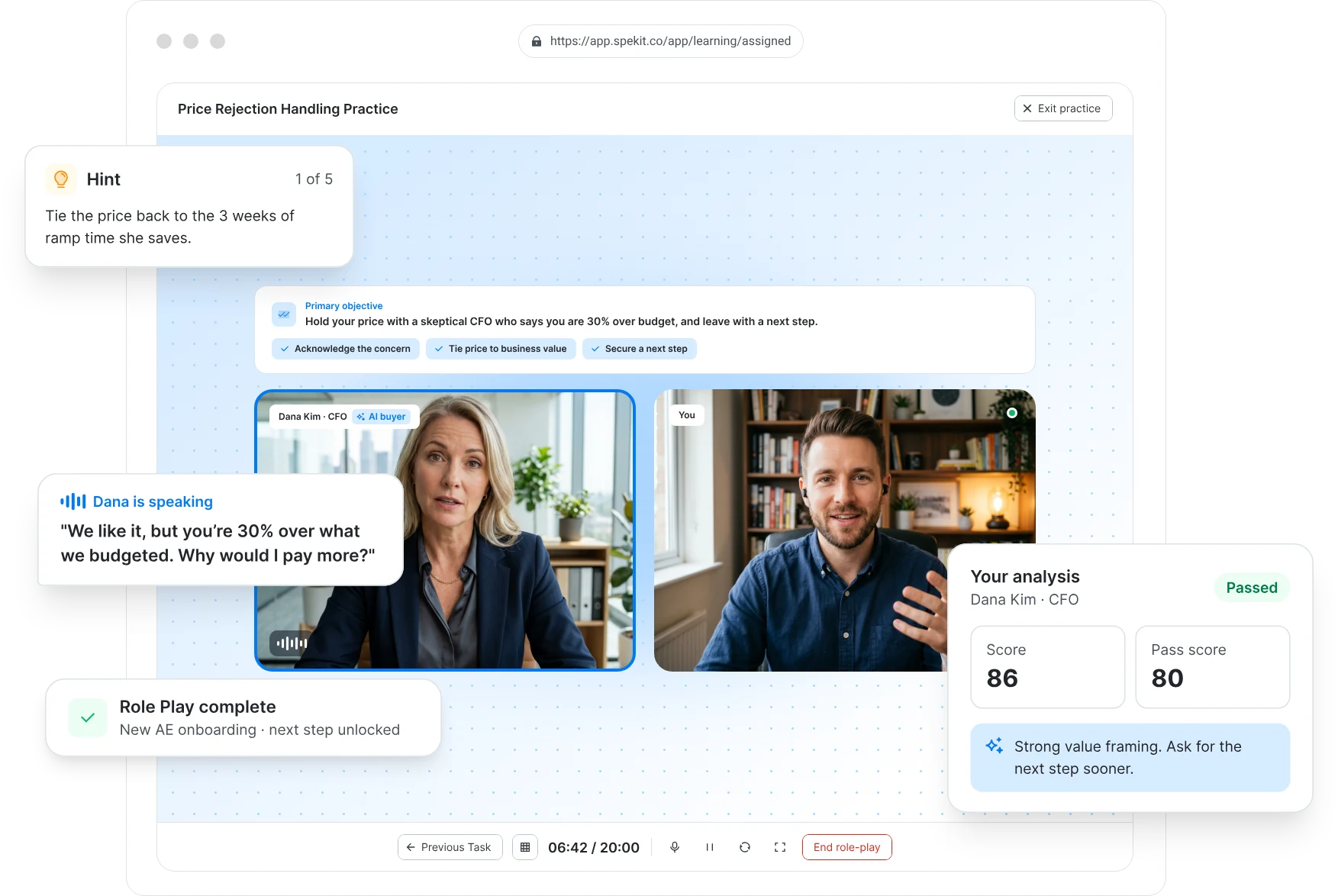
Active deals create specific questions about pricing, competitors, customer proof, and follow-up. AI Sidekick uses the rep's workflow and deal context to provide relevant coaching, approved content, and next steps without making the rep assemble the answer across several tools.
| What is happening | What the rep gets | What they can do next |
|---|---|---|
| An opportunity enters the proposal stage | What the rep getsPricing guidance, relevant customer proof, and an approved follow-up template | What they can do nextPrepare a compliant proposal and tailored follow-up |
| A buyer mentions a competitor | What the rep getsThe current battlecard, objection coaching, and supporting proof | What they can do nextRespond using approved positioning |
| A call ends with agreed next steps | What the rep getsA call summary, recommended content, a follow-up draft, and a digital sales room | What they can do nextReview, personalize, and send the buyer experience |
Governed content and deal context can also become an executive summary, mutual action plan, business case, or other content in an AI Deal Room. Engagement data shows which stakeholders visited, what they viewed, and where follow-up may help.
A rollout succeeds when people use the new product information, message, or process correctly in calls, emails, account decisions, and content creation. An announcement or course creates awareness; reps still need help applying the change.
The owner updates the approved source once, and the change appears in the learning, in-workflow guidance, coaching, content, and AI responses used by the affected teams. Notifications explain what changed; updated guidance helps people apply it. AI assistants and agents access the same knowledge through MCP.
Engagement data and unanswered questions show where the change remains unclear. Enablement teams can add explanation, provide coaching, or correct the source before a missed target reveals the problem.
Start with one problem sellers encounter repeatedly, such as handling a competitor, following up after a call, or adopting new messaging. Solving one defined problem makes it easier to judge whether the support is useful before expanding the program.
A pilot is useful only when the team can tell whether it improved the work. Track four kinds of evidence:
| What to measure | Examples |
|---|---|
| Whether the content can be trusted | ExamplesOwnership, freshness, duplication, unanswered questions |
| Whether reps can use it | ExamplesRelevance, active use, repeat use, readiness, time to answer, manager escalations |
| What reps and buyers do next | ExamplesActions completed, content created or shared, digital sales rooms created, buyer engagement |
| Whether the business result changes | ExamplesRamp time, seller capacity, conversion, cycle time, pipeline influence, revenue impact |
Choose metrics that match the problem. A team trying to reduce manager dependence should track repeated questions and successful self-service. A product launch should track knowledge gaps, use of the new messaging, and performance in affected deals. To make the comparison more reliable, measure results before and after the pilot, compare the pilot group with similar reps, or use a controlled pilot where practical.
Most revenue teams manage content, deal context, rep support, and performance data in separate systems. Spekit brings those systems together so teams can manage approved knowledge, use it to help reps act, and see what happened afterward.
When a team updates knowledge in Spekit, that change can reach seller workflows, buyer experiences, and AI-generated work. The team can then see whether people used the new information.
Just-in-time enablement is an approach to revenue enablement that delivers content, coaching, learning, and next steps to a rep or an AI assistant at the moment the work is happening, instead of requiring a separate search or a visit to a portal. It covers the same scope as traditional enablement (content, training, coaching, guidance, and measurement) but changes how that support reaches the person or system that needs it.
A learning management system delivers structured courses on a schedule, usually before or after the work happens. Just-in-time enablement includes learning as one piece, but adds live coaching, content recommendations, and next-best actions triggered by the rep's actual task, deal, or conversation. An LMS can tell a rep what to know; just-in-time enablement also surfaces the answer while they are acting on a live deal.
A content portal or repository stores approved material in one place and expects the rep to search for it. Just-in-time enablement still needs a governed source of content, but it pushes the relevant piece into the workflow, such as a CRM record, an email draft, or a call in progress, rather than waiting for the rep to remember the portal exists and go look.
Start by finding where reps already work, such as Salesforce, email, Slack, or Gong, and move the highest-value content and guidance into those tools instead of asking reps to visit the portal. Keep governance (ownership, permissions, and freshness) on the underlying content so the answers delivered in the workflow stay accurate, then track whether usage and repeat questions to managers actually drop before retiring the old portal.
Spekit is built specifically around in-workflow delivery through AI Sidekick and Spekit MCP. Highspot and Seismic, one company since their August 2026 merger, deliver some content inside Salesforce and Outlook through their own integrations, though both are built around a central portal first. Guru delivers company-wide knowledge inside Slack and a browser extension, and Salesforce Sales Programs delivers enablement content natively inside Salesforce, but only inside Salesforce.
Yes, when the underlying content is governed and exposed through a protocol built for that purpose. Spekit MCP gives connected AI assistants and agents permission-aware access to the same approved GTM knowledge that powers AI Sidekick, so an agent's answer and a rep's answer come from the same source instead of two different ones.