A digital adoption platform (DAP) helps people across an organization adopt technology and complete work in software. A revenue enablement platform helps customer-facing teams become more effective at selling and serving customers. That includes adopting new tools, processes, messaging, and playbooks, but extends to content, learning, coaching, buyer engagement, and the decisions people make throughout a deal. The categories can overlap in how they deliver guidance; their difference is the scope of the problem they are built to solve.
If your priority is helping employees adopt software across departments, start with a DAP. If your priority is helping revenue teams apply the right knowledge and actions at each customer moment, start with a revenue enablement platform. Spekit® is an AI-first revenue enablement platform. It supports digital adoption use cases for revenue teams without being a DAP.
What is the difference between a DAP and a revenue enablement platform?
Digital adoption platform and revenue enablement platform comparison
| Question |
Digital adoption platform |
Revenue enablement platform |
| What is its main job? |
Digital adoption platformDrive technology adoption and help people complete software workflows across the organization |
Revenue enablement platformImprove the effectiveness of customer-facing teams throughout the revenue process |
| What content is central to the program? |
Digital adoption platformGuidance for using applications and completing software workflows |
Revenue enablement platformGoverned GTM knowledge, sales content, plays, learning, coaching, and buyer-facing material |
| Where does guidance appear? |
Digital adoption platformOn or across the applications where users complete tasks |
Revenue enablement platformAcross revenue workflows, including selling tools, email, calls, content, and buyer interactions |
| Who usually owns the program? |
Digital adoption platformIT, operations, transformation, or an application owner |
Revenue enablement platformRevenue enablement, sales leadership, product marketing, or revenue operations |
| What outcomes should you evaluate? |
Digital adoption platformSoftware adoption, task completion, errors, and workflow friction |
Revenue enablement platformReadiness, adoption of tools and plays, content use, buyer engagement, and revenue outcomes |
These are starting points, not feature limits. WalkMe describes guidance and workflow automation, while Whatfix describes content management as well as in-app guidance and analytics. A DAP can govern its own guidance; a revenue enablement platform can support technology adoption for revenue teams. Compare the primary program each product serves and the outcomes it can actually show.
Is Spekit a digital adoption platform?
No. Spekit is an AI-first revenue enablement platform. Its GTM Knowledge Engine and content hub give enablement teams a governed source for approved messaging, sales content, and learning. Spekit can draw on that knowledge in embedded guidance, Learning Paths, AI Sidekick, and buyer-facing experiences. If a pricing rule changes, the team can update its approved source and check where linked guidance and content use that rule, rather than treating each prompt as an isolated instruction. This is how Spekit supports adoption of new tools, processes, messaging, and playbooks as part of Enablement in the Flow of Work® and Just-in-Time Enablement®.
That is a digital adoption use case within revenue enablement, not Spekit's platform category. The broader goal is to help customer-facing teams use approved knowledge and take effective action throughout the customer journey. If the requirement is technology adoption across HR, finance, and operations, compare a general-purpose DAP against those tasks as well.
What is a digital adoption platform?
A digital adoption platform helps people use technology effectively across an organization. It adds assistance to software so users can learn and complete processes while doing them. Depending on the product, that may include field tips, step-by-step walkthroughs, self-service answers, workflow automation, and analytics that show where people get stuck. Some DAPs serve employees across business systems; others support customers learning a software product. Confirm which audience and applications a vendor supports.
The DAP's focus is technology adoption. For example, an operations team rolling out a new expense system might guide employees through submitting a claim and check where submissions fail. The program is judged primarily by whether people use the software and finish the task correctly.
What is a revenue enablement platform?
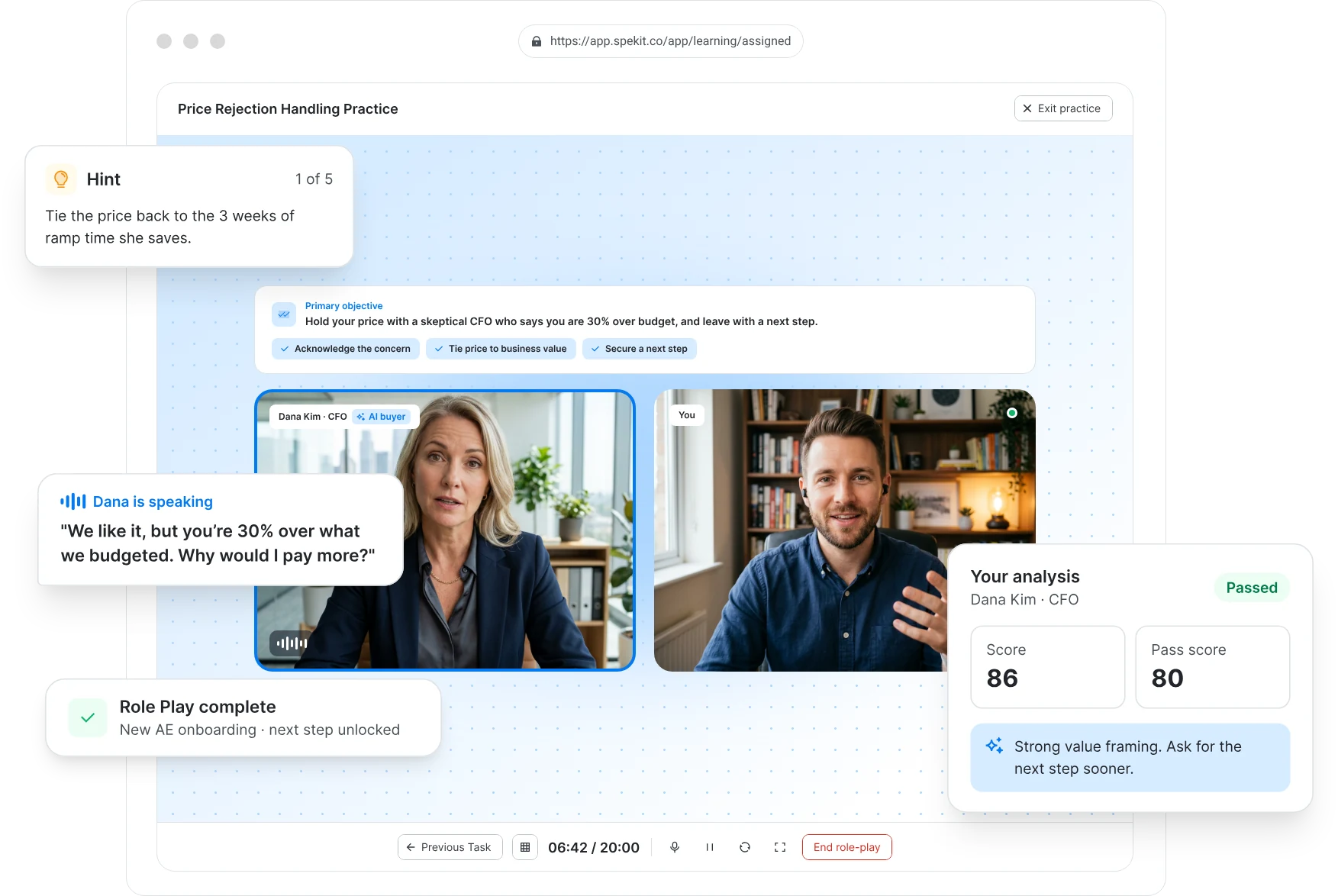
A revenue enablement platform helps sales and other customer-facing teams perform effectively throughout the customer journey. It can combine a governed content library, training, coaching, sales plays, buyer experiences, and analytics, then make approved guidance usable when a rep is preparing for a meeting, handling an objection, updating an opportunity, or following up with a buyer.
The platform's focus is customer-facing effectiveness. Suppose a company changes its discount policy. Reps need to adopt the new process, know the approval rule, explain it accurately to buyers, use the right terms in a quote, and find the current talk track later. A revenue enablement program supports all of that work. A tip inside a selling tool may help at one point, but the policy, learning, content, and measurement extend beyond that screen.
“Sales enablement” often describes the practice focused on sellers. “Revenue enablement” extends the scope to other customer-facing roles and stages. Technology and process adoption matter within that scope because they help the team execute; they are not the platform's entire purpose.
Where do digital adoption and revenue enablement overlap?
The overlap appears when a revenue team adopts a new tool or process. A DAP might guide a rep through the steps of using the software. A revenue enablement platform might help the rep adopt that process while also providing the underlying policy, approved messaging, learning, and buyer-facing content. Both can deliver in-app help, and a capable product in either category may support parts of both jobs.
The difference becomes clearer when the rule changes. Ask where the approved definition lives, who can update it, and which guidance draws from it. Test whether linked material reflects the change and identify separately authored assets that still need review. A DAP may manage and reuse its own guidance too; the question is whether the system governs the GTM knowledge and buyer-facing execution the revenue team depends on. That determines how quickly a new rule reaches the people who must use it.
Analytics need the same scrutiny. Walkthrough completion, where tracked, shows that a user finished the guided steps; it does not by itself prove the task was done correctly or that the rep used the right message with a buyer. Conversely, content engagement does not prove a software task was completed correctly. Ask which signals each product records, then judge them against the outcome you are buying.
When should you choose a DAP, a revenue enablement platform, or both?
Start with a DAP when the main problem is technology adoption across the organization: a new ERP or HR system, repeated errors in software tasks, or low use of applications across departments. Test the specific applications, screens, and workflows you need to support. If the project includes sales content or coaching, confirm how that material will be governed and maintained.
Start with a revenue enablement platform when the main problem is customer-facing effectiveness: inconsistent messaging, outdated decks, slow onboarding, poor play adoption, or sellers switching between tools to find answers. Include adoption of new revenue technology and processes in the evaluation. Test whether the platform can govern the source material and deliver it at the moments reps need it, including inside software where relevant.
Use both when there are two substantial programs: technology adoption across departments and broader revenue enablement for customer-facing teams. Define which system owns each instruction, how changes move between them, and whether users will see conflicting guidance. A two-platform stack is justified when the extra depth outweighs the integration and maintenance work.
How can you test which platform you need?
Pick one consequential change, such as a new pricing policy that reps must apply and explain to buyers. Use the same scenario for each product:
- Complete the task. Can a new rep find and follow the correct steps in the live application?
- Explain the decision. Can the rep find the approved policy and the buyer-facing explanation, not just the click path?
- Change the rule. Have the owner update the approved policy. Check which linked surfaces reflect the change, which independently authored assets need review, and whether outdated guidance remains visible. In a Spekit pilot, follow the source through embedded guidance, learning, AI answers, and buyer content where those surfaces are in use.
- Follow the work across tools. Check what the rep sees while preparing, using a selling tool, communicating with the buyer, and sharing buyer-facing material.
- Inspect the evidence. What does the product actually report about software use, content use, learning, and buyer or deal activity? Record the available measures and their limits; none alone proves the business outcome.
If the DAP proposal is meant to serve the whole company, repeat the test in a non-revenue application. This produces a clearer decision than a feature checklist: it shows whether the problem is technology adoption across the organization, effectiveness across the customer-facing team, or both, and what it will take to keep guidance accurate after launch.
See how Spekit delivers embedded revenue enablement.













 Sales Enablement